
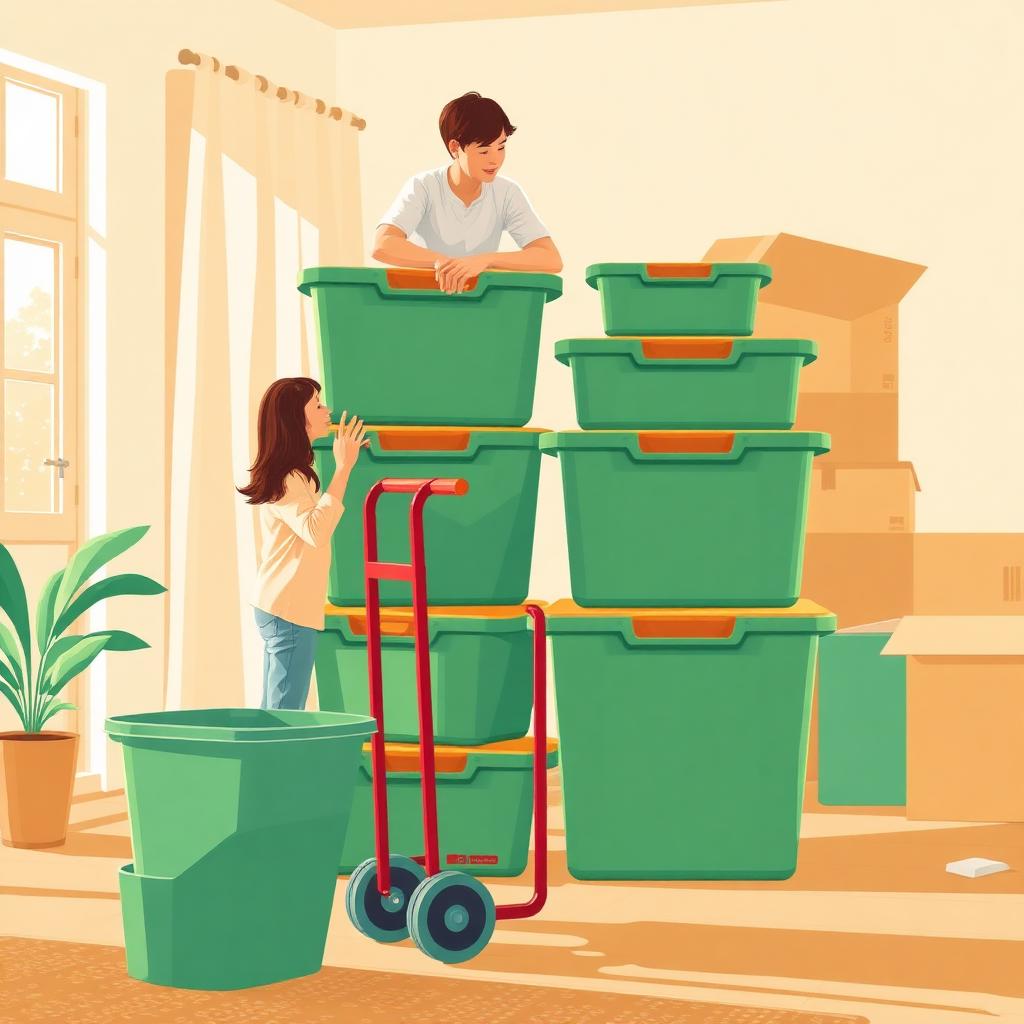
After hundreds of moves across Ventura County, the same packing mistakes come up over and over — and most of them trace back to the container, not the person doing the packing. Here are the seven we see most often and how reusable plastic totes solve each one.
1. Overloading cardboard until it breaks
Cardboard is forgiving until it isn't. Families fill a box, it feels fine, so they add just a bit more — then halfway down the stairs the bottom gives out. Cardboard flexes under weight, and its structural integrity depends on staying dry. In our coastal climate, humidity creeps in fast: a box rated for 65 lb may only safely hold 40 lb after a night in a garage.
Our 27-gallon plastic totes have rigid walls and reinforced corners rated for a consistent 65 lb load. A full tote looks and feels the same as a half-full one. Pack to the top, stack it, move on.
2. Mixing fragile items with heavy belongings
Most families pack sequentially, room by room — glasses end up on top of cookbooks, framed photos under stacked sweaters. Weight distribution is the biggest single cause of moving damage.
With totes, sort by weight category instead of by room. Dedicate one tote to dishes and glassware (lined with soft materials), another to books and tools. The rigid, uniform footprint makes stacking predictable, and rounded corners plus built-in handles reduce impact during load-in.
- Heavy tote: books, kitchen tools, small appliances.
- Fragile tote: glassware, dishes, decor.
- Soft tote: linens, clothing, pillows — great cushioning layer between fragile totes in the truck.
3. Packing material that shifts in transit
Newspaper and crumpled paper compress during the drive. A tote that felt secure at home becomes a bag of loose, shifted items 25 miles later. Cardboard makes this worse — the box itself deforms as contents shift.
Rigid totes hold their exact shape from door to door. Combined with bubble wrap for dishes, kraft paper for cushioning, and furniture pads for larger fragile pieces, everything stays exactly where you put it. See our moving checklist for a room-by-room material guide.
4. Vague or missing labels
"Kitchen" tells you the room but not whether it's everyday dishes or fine glassware. Half of unpacking chaos comes from labels that either faded, got taped over, or never got written.
A two-part label system on totes works far better than anything you can do with cardboard:
- Line 1 — Room: large, high-contrast, visible from the truck.
- Line 2 — Contents: 3–5 specific items so you know what's inside without opening.
- Color code: lid color or a colored strip of tape per room (kitchen = one color, primary bedroom = another).
Because our totes stay intact, some families even photograph each packed tote and note contents in a simple spreadsheet — a permanent inventory for the next move.
5. Cardboard that collapses on trip two or three
Most moves aren't a single truck run — they're two or three trips over a weekend, or a staged move across a couple of weeks. Cardboard degrades with every reuse. By trip three, boxes are visibly bowed, and if any moisture got in on day one, the bottoms split.
Plastic totes are unchanged on trip five. This is a big reason we've become popular for staged moves — pack half the house Saturday, move Sunday, finish the following weekend. See lead times if you're planning a multi-weekend move.
6. Wasting hours on box assembly and tape
Cardboard requires assembly: break down flat boxes, fold the bottom flaps, tape the seams. That's 3–5 minutes per box. Fifty boxes for a 3-bedroom move is 3–5 hours of pure prep, plus another hour of tape wrangling.
Totes arrive ready. No assembly, no tape, no prep. You unload them from the delivery truck and start packing. Add another 1–2 hours saved on the back end because you don't break down and haul cardboard to recycling — we pick the totes up.
Rough time math for a 3-bedroom move:
- Cardboard: ~4 hrs assembly + ~1 hr tape + ~2 hrs disposal = ~7 hrs of overhead.
- Totes: 0 hrs. You're packing minute one and done minute one on pickup.
7. Waste that families feel bad about later
A 3-bedroom move uses 50–70 cardboard boxes. Most are dirty, taped, or crushed by the end — a lot get landfilled even in cities with recycling because contaminated cardboard is often rejected.
Each of our totes cycles through dozens of moves over its life, replacing hundreds of single-use boxes. A single family's move using totes instead of cardboard prevents roughly 60 boxes from being manufactured and discarded. It's a small but real environmental win, and one many Ventura County families explicitly ask about.
What to do next
Match your rental to your home size and stop fighting the container. We deliver free across Thousand Oaks, Oxnard, Ventura, Camarillo, Simi Valley, Moorpark, and Santa Paula. Every package includes a dolly, a full week of rental (10 days on 4-bedroom), and our free damage-swap guarantee — if a tote arrives compromised, we replace it.
- Studio — $119
- 1-Bedroom — $149
- 2-Bedroom — $199 (most popular)
- 3-Bedroom — $299
- 4-Bedroom — $379
Questions? Text Jason at (805) 273-8732.