
Why most movers underestimate packing complexity
Moving day arrives faster than most people expect. One week before your Ventura County relocation, panic sets in when you realize how much actually needs to be packed. Most movers underestimate both the volume of items and the mental effort required to organize everything logically. A structured room-by-room approach — combined with the right containers — is the difference between chaos and a smooth transition.
People usually fall into one of two traps: they pack randomly, grabbing items as they see them, or they delay until the last possible moment and rush. Both create inefficiency, forgotten items, and boxes at the wrong destination.
The real complexity is in the invisible layers: everyday items you use constantly (kitchen dishes, toiletries, work clothes), seasonal inventory (holiday decorations, winter gear), sentimental objects that need careful handling, and the mysterious items that live in closets because you haven't touched them in two years. Each category needs a different packing strategy, protection level, and labeling approach.
Weight distribution is another overlooked factor. Heavy items packed together create totes that are impossible to carry, while loosely packed ones waste valuable space. That inefficiency compounds across a three-bedroom home.
What to do next: Before opening a single tote, spend 20 minutes mentally walking through each room and listing major item categories. You'll be surprised how many distinct groups exist beyond "bedroom stuff" or "kitchen things."
How our rental system simplifies room-by-room organization
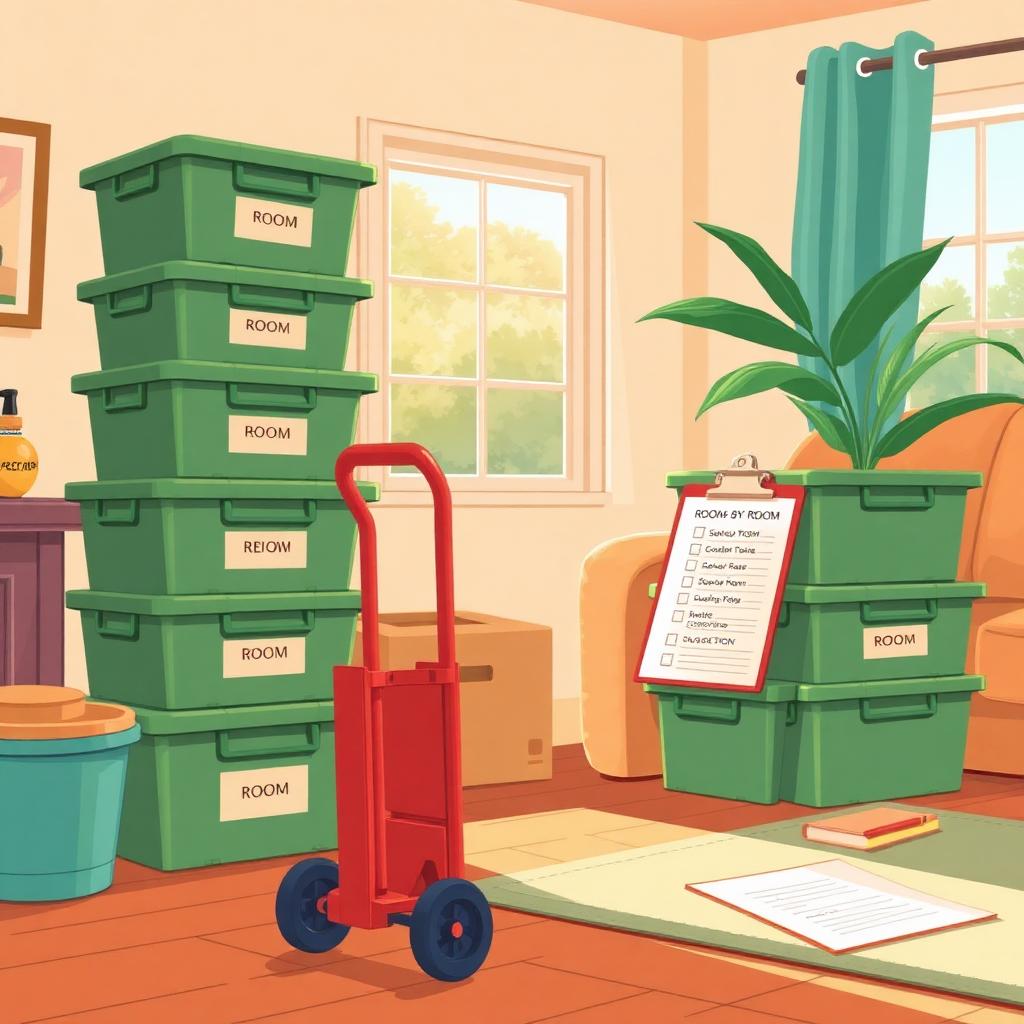
Our 27-gallon plastic totes (27" x 17" x 12", 65 lb capacity) are industrial-strength, uniform, and stackable. Because every tote is identical, you know exactly how many you need and how they'll fit together. Every rental includes free delivery and pickup countywide plus a heavy-duty dolly to move fully loaded totes without strain — no tape, no assembly, no cardboard corners to wrestle.
With standardized containers, labeling becomes consistent and searchable. Number the totes, assign them to rooms, and you'll immediately know which one holds what. The system scales cleanly from a studio to a four-bedroom home.
What to do next: Tell us your home size when you reserve and we'll recommend the exact tote count. That removes the guesswork and prevents running out of totes mid-packing.
Studio apartment checklist (8–10 totes)
Studios reward ruthlessness. Every item has to earn its spot. Categorize first:
- Kitchen: dishes, cookware, food items — 2 totes.
- Bedroom & personal: bedding, pillows, clothes, shoes — 2–3 totes.
- Bathroom: toiletries, meds, linens — about half a tote.
- Living area: books, electronics, decor — 2–3 totes.
- Miscellaneous: office, tools, cleaning — 1 tote.
Pack kitchen first (least urgent at your destination). Stack plates vertically with towels between layers. Clothing gets its own tote; hangers stay on hangers, everything else folded by category. One tote handles bedding, pillows, and towels — they compress well and form a natural bundle.
Timeline: kitchen and bathroom one week out, books and decor 3 days out, clothes and bedding the day before.
What to do next: Measure your new studio before packing. If it's smaller, this is your moment to downsize.
1-Bedroom checklist (12–15 totes)
One-bedroom homes introduce a real bedroom plus a living space, which means more categories and the temptation to overstuff "bedroom" totes. Separate daily-use items from everything else and pack the bedroom last — you'll wear from your closet up until moving day.
- Bedroom (3–4 totes): clothing by season, shoes, bedding, nightstand and dresser contents.
- Kitchen (2–3 totes): one for dishes and glasses, one for pots and pans, one for food storage and small appliances.
- Living + dining (2–3 totes): books, decor, electronics with cords wrapped, throws.
- Bathroom (1 tote): toiletries in a plastic bag, meds, towels, cleaning.
- General household (2–3 totes): tools, cleaning, seasonal decor, cords.
Packing time: 8–12 hours across 3–4 evenings.
What to do next: Photograph every closet and major furniture piece before you pack — it's your quick reference if you need to confirm tote counts with us.
2-Bedroom checklist (18–22 totes)
Two-bedroom homes are where room-by-room organization becomes essential rather than optional. Without clear separation, bedroom items leak into living-room totes, kitchen overflow spills into hallway boxes, and nothing finds its home.
- Master bedroom (3–4 totes): clothes, shoes, bedding, nightstand, jewelry.
- Second bedroom (2–3 totes): guest room decor, office supplies, hobby, seasonal storage.
- Kitchen (3–4 totes): breakables separated from cookware, small appliances, food storage.
- Bathroom (1–2 totes): toiletries and linens.
- Living, dining, hallway (3–4 totes): books, electronics, decor, artwork.
The second bedroom needs the most discipline — old school supplies, sports equipment, hobby materials all consolidate here. Label every tote with both a number and a room destination and keep a master list.
What to do next: Start with the second bedroom (used least), then kitchen and bathroom, then bedrooms and living areas last. This sequence maintains daily functionality while steadily building momentum.
3-Bedroom checklist (25–30 totes)
Three-bedroom homes are where advanced strategy separates smooth moves from stressful ones. Create a master inventory in your phone's notes app — tote numbers, rooms, and major items. On arrival at your new home, that list is your unpacking roadmap.
- Master bedroom (4–5 totes): prioritize comfort items in easily accessible totes.
- Secondary bedrooms (3–4 + 2–3 totes): sub-categorize by function — guest, kid's room, or office.
- Kitchen (4–5 totes): one for breakables, one for cookware, one for small appliances, one for food storage and utensils.
- Living + dining (4–5 totes): books in their own tote (heavy), decor and artwork together, electronics with organized cording.
- Bathrooms (2 totes): medicine cabinet in one section, linens in another, waterproof bag for leak-prone bottles.
- Laundry, storage, misc (3–4 totes): tools, cleaning, seasonal decor, hobby supplies.
What to do next: Number your totes before packing begins, not after. It prevents confusion and makes it easy to tell us "Tote 12 has master-bedroom items" when coordinating pickup.
Kitchen essentials: fragile items and heavy loads
Kitchens balance fragile glassware, heavy cookware, and items you might need immediately at your new place. Separate fragile from non-fragile first. Stack plates vertically with towels or packing paper between each layer — that uses space efficiently while protecting against cracks.
Cookware becomes extremely heavy quickly. Don't fill an entire tote with pots and pans alone — mix in lighter items like food-storage containers or utensils so weight distributes and you can still lift it. Small appliances go in their original boxes when possible; otherwise wrap in kitchen towels and nestle among lighter items.
Glassware needs individual wrapping — packing paper, dish towels, or old t-shirts. Stack snugly so items can't shift, then fill gaps with more cushioning. Knives get blade guards or cardboard sleeves so they can't puncture other items or hands.
What to do next: Before packing kitchen items, assess what you actually use weekly versus what sits in cabinets untouched. Moving day is a natural chance to lighten kitchen clutter.
Bathroom and bedroom: what most people forget
Bathrooms are deceptively complex. Beyond toiletries and medications, people forget towel hooks, shower caddies, bath mats, shower curtain rods, plungers, trash cans, and mirror organizers. Meds travel in a small sealed container; toiletries go in a waterproof bag before entering the tote. Towels and linens bundle loosely and double as cushioning for fragile items.
In bedrooms, most people pack clothes but forget the furniture itself. If you're taking dressers, nightstands, or bed frames, empty drawers completely, wrap components, and label each piece with its destination room. Pack away-season clothes first; keep two weeks of everyday clothes accessible until moving day.
Commonly forgotten bedroom items: nightstand contents, closet shelving, under-bed storage, hangers (bring plenty), wall art, mattress protectors, and bed skirts.
What to do next: Do a deep closet and bathroom-cabinet purge before packing. Everything that leaves your current place should have a purpose at your new one. Fewer totes, faster unpack.
Maximizing our totes: packing density without damage
Our totes are designed for optimal density, but there's a skill to it. Place heavy items on the bottom — cookware, tools, heavy books, dense decor — then layer lighter items on top. For fragile items, create a "safe zone" in the middle or top surrounded by towels, clothing, or linens; never place fragile items directly against tote walls without at least two inches of soft buffer.
A properly packed tote should be full but with the lid able to seal without forcing. Books stand upright like they're on a shelf rather than stacking flat — that distributes weight and protects spines. When stacking, heaviest totes go on the bottom; interleave rather than piling all light totes on top of all heavy ones.
What to do next: When we deliver, ask for one extra tote beyond what you think you'll need. A buffer tote prevents the last-minute scramble when you discover you're one short.
Reusable totes vs cardboard
Cardboard requires assembly and tape — five minutes per box adds up to an hour before you even start packing. Our totes arrive ready to use. Cardboard deteriorates during a move and softens if the weather turns damp; our totes stay rigid and weather-sealed. And every rental keeps roughly 40 cardboard boxes out of the landfill.
For a full cost comparison, see rent vs buy moving boxes. For a competitive breakdown, read 805 Totes vs PODS vs full-service movers.
Your complete moving timeline
- 3 weeks out: Sort. Create a donate/sell pile before you pack anything.
- 2 weeks out: Reserve totes. Order slightly more than you think you need.
- 10–8 days out: Low-use areas — second bedroom, garage, seasonal items.
- 7–5 days out: Non-daily kitchen and bathroom items, serving dishes, specialty cookware.
- 4–2 days out: Living areas — books, decor, entertainment, artwork, office.
- 1–0 days out: Master bedroom, everyday clothing, daily toiletries, everyday dishes. Pack a "first night" tote with toiletries, chargers, and a change of clothes.
- Moving-day morning: Final walkthrough of closets, cabinets, and drawers. Then we handle pickup.
Use the printable moving checklist to keep the timeline visible on the fridge.
The local angle
We're a family-owned Ventura County business serving Thousand Oaks, Newbury Park, Camarillo, Oxnard, Ventura, Simi Valley, Moorpark, and Santa Paula. Free delivery and pickup are included with every rental. Text Jason at (805) 273-8732 if you want help sizing the right package for your move.