
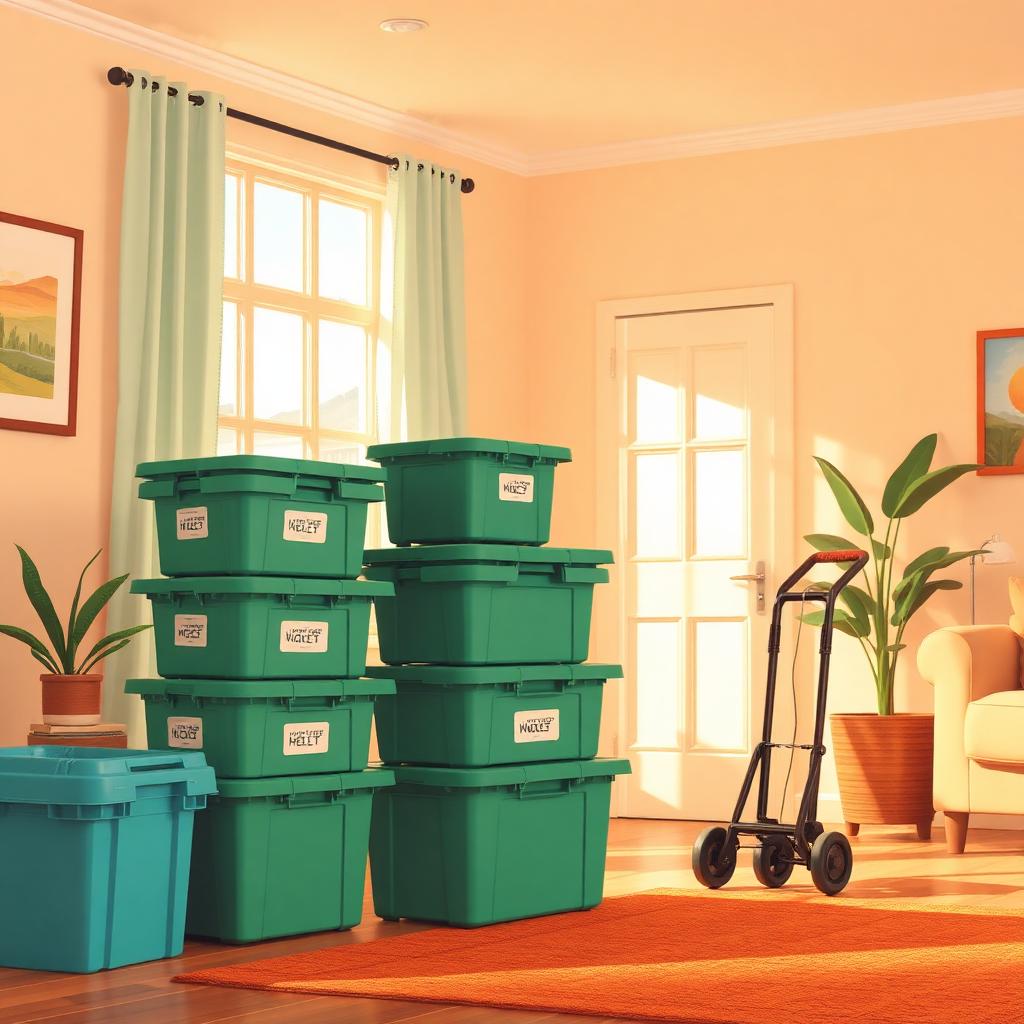
Moving day stress usually peaks during packing, not during the drive. Most checklists you'll find online are built around cardboard boxes, which means they miss what actually makes a Ventura County move easier: rigid, reusable totes that stack, don't collapse, and come with a dolly. Here's a room-by-room checklist built specifically for how our totes work.
Why standard packing checklists fall short for totes
Cardboard-focused advice assumes flimsy walls. "Fill to 70% capacity," "double-tape the bottom," "don't stack heavy on light" — all of that exists because boxes fail. Our 27" x 17" x 12" totes hold up to 65 lbs, keep their shape, and stack without crushing what's underneath.
- Uniform sizing: Every tote is the same, so you can plan exact counts before you pack a single item.
- No tape, no assembly: Load, snap the lid, stack. Nothing to build and nothing to break down later.
- Organization holds: Rigid walls mean the way you packed a tote is the way it arrives.
How the tote system simplifies room-by-room packing
Most local moves happen room by room, so the rental is built that way too. Free delivery and pickup countywide, a dolly included with every package, and a rental window that fits a normal move — 5 days for studio and 1-bedroom packages, 7 days for 2-bedroom and up, extendable for $20 a day for the first 3 days, then $12/day (10-day max) if your closing date slips.
Rough planning numbers: a studio runs about 18–22 totes, a two-bedroom around 36–45, and a three-bedroom typically 48–60. Our package tiers are sized to those counts already, so pick the tier that matches your home and you're covered. For the full math, see our tote count guide by home size.
Kitchen: what fits in one tote
The kitchen is the most time-intensive room in any house. Break it into four totes and it stops being overwhelming.
- Dishware: Wrap each plate in paper, stack them upright on edge (never flat), nest bowls. One tote holds roughly 12–16 place settings.
- Glassware: Line the bottom with towels, stand glasses upright, separate rows with paper. Typically 24–30 glasses per tote.
- Cookware: Layer pots and pans with kitchen towels between each piece. A full cookware set plus baking sheets fits in one.
- Pantry: Heavy cans on the bottom, boxed goods above, spices tucked into the gaps.
Small appliances go in their own tote with padding between each unit — original boxes are great secondary protection if you kept them. Kitchen linens and aprons compress well and are perfect gap-filler in totes that already hold heavy items.
Bedrooms and closets
Bedrooms are your biggest volume of soft goods, and they pack fast once you have a system.
- Hanging clothes: Leave them on the hangers, group by type, lay them flat across the tote. About a month of daily wear per tote.
- Bedding: Keep all bedding for one bed in one tote. Unpacking becomes one container per bed.
- Shoes: Wrap pairs individually, place them sole-to-sole standing upright. That fits 12–18 pairs instead of 6–8 laid flat.
- Nightstand items: Jewelry, medications, and sentimental pieces get their own labeled pouch inside a tote so they never disappear into a corner.
Living room and fragile items
Books are heavier than you think. Never fill a tote with books alone — you'll hit the 65 lb limit fast and nobody will want to lift it. Fill the bottom third with books and top it with pillows, throws, or framed photos.
- Electronics: Original boxes if you have them, otherwise wrap each component in a moving blanket. The included dolly handles the awkward carries.
- Art and mirrors: Wrap individually and stand them upright in the tote, never flat-stacked. Spread several pieces across two totes rather than overloading one.
- Furniture hardware: Bolts and legs into a labeled bag, taped to the piece itself. Large furniture travels separately — totes are for everything else.
Bathroom and laundry room
This is the room people leave for the last hour, and it's the one most likely to leak on everything else.
- Liquids on top: Shampoo, cleaners, and skincare go in the top layer so a leak can't cascade down. A small plastic bin inside the tote works as spill containment.
- Cleaning supplies separate: Their own tote, never mixed with clothing or dishware.
- Medications with you: Prescriptions, vitamins, and anything you take daily should ride in your car, not in a tote.
- Towels as padding: Bath linens compress well and fill gaps in totes holding harder items.
Your printable room-by-room checklist
Kitchen: dishware (1) · glassware (1) · cookware and bakeware (1) · pantry (1) · small appliances (1) · linens (gap filler)
Bedroom, per person: clothing (1) · bedding (1) · shoes and accessories (1) · nightstand items (shared)
Living room: books and decor (1–2) · framed art upright (1) · lamps and breakables (1) · cushions (gap filler)
Bathroom: toiletries (1) · cleaning supplies (1) · towels and linens (1)
Every move: total your tote count · confirm delivery date · confirm pickup date · label every tote with room + contents · keep a list of high-value items · never mix heavy and fragile.
Our full moving checklist page covers the non-packing side — utilities, address changes, and week-of logistics.
Packing timeline that matches your rental window
- 2 weeks out: Walk each room, count totes, and reserve your delivery date. Peak weekends in Ventura County fill up first.
- 10 days out: Nothing yet — this is when you purge. Donate, sell, and toss so you're not paying to move things you don't want.
- Delivery day: Start with the kitchen. It's the slowest room and you can keep cooking with a few essentials out.
- Days 2–3: Bedrooms and closets. Off-season clothing first, daily wear last.
- Days 4–5: Living room and bathroom — the fragile rooms that reward slowing down.
- Day before: One "first night" tote per person: sheets, toiletries, a change of clothes, phone chargers.
- Move day: Load the dolly 3–4 totes at a time and group by destination room.
Six mistakes this system prevents
- Overpacking: Rigid walls won't flex, so you physically can't create the bulging box that collapses on the stairs.
- Mixing rooms: Assigning totes to rooms up front stops the "grab whatever's nearby" spiral.
- Bad labeling: Smooth plastic takes a marker or label cleanly and stays readable — wet cardboard doesn't.
- Heavy on fragile: Cookware and books get their own totes, away from glassware.
- Skipping padding: Towels and linens you're already moving double as free cushioning.
- Inconsistent density: Category-based packing keeps totes evenly filled so the truck stacks flat.
The local angle
We're a family-owned Ventura County operation — Jason and Jessica — and we deliver and pick up free across Thousand Oaks, Newbury Park, Camarillo, Oxnard, Ventura, Port Hueneme, Simi Valley, Moorpark, and Santa Paula. Every rental includes the totes, a dolly, and a free swap if any tote shows up damaged. Questions about how many you need? Text us at (805) 273-8732 and we'll size it with you.
♻️ Every rental keeps roughly 40 cardboard boxes out of the landfill.